Tuesday, March 17, 2009
opinion
I thought El Salvador was an excellent country. It had so many cool tourist attractions. It would be a cool place to go.

Food


Traditional Salvadoran cuisine consists of food from the Maya, Lenca, and Pipil people.
Many of the dishes are made with maize (corn).
Many of the dishes are made with maize (corn).
History
The Pipil Indians, descendants of the Aztecs, likely migrated to the region in the 11th century. In 1525, Pedro de Alvarado, a lieutenant of Cortés's, conquered El Salvador.
El Salvador, with the other countries of Central America, declared its independence from Spain on Sept. 15, 1821, and was part of a federation of Central American states until that union dissolved in 1838. For decades after its independence, El Salvador experienced numerous revolutions and wars against other Central American republics. From 1931 to 1979 El Salvador was ruled by a series of military dictatorships.
In 1969, El Salvador invaded Honduras after Honduran landowners deported several thousand Salvadorans. The four-day war became known as the “football war” because it broke out during a soccer game between the two countries.
El Salvador Suffers During 12-Year Civil War
In the 1970s, discontent with societal inequalities, a poor economy, and the repressive measures of dictatorship led to civil war between the government, ruled since 1961 by the right-wing National Conciliation Party (PCN), and leftist antigovernment guerrilla units, whose leading group was the Farabundo Martí National Liberation Front (FMLN). The U.S. intervened on the side of the military dictatorship, despite its scores of human rights violations. Between 1979 and 1981, about 30,000 people were killed by right-wing death squads backed by the military. José Napoleón Duarte—a moderate civilian who was president from 1984 to 1989—offered an alternative to the political extremes of right and left, but Duarte was unable to end the war. In 1989, Alfredo Cristiani of the right-wing Nationalist Republican Alliance (ARENA) was elected. On Jan. 16, 1992, the government signed a peace treaty with the guerrilla forces, formally ending the 12-year civil war that had killed 75,000.
In 1998, Hurricane Mitch devastated the country, leaving 200 dead and over 30,000 homeless. In Jan. and Feb. 2001, major earthquakes struck El Salvador, damaging about 20% of the nation's housing. An even worse disaster befell the country in the summer when a severe drought destroyed 80% of the country's crops, causing famine in the countryside.
In 2004, Antonio Saca of ARENA was elected president. The nation implemented a free-trade agreement (CAFTA) with the U.S. in March 2006, the first Central American country to do so.
http://www.infoplease.com/ipa/A0107489.html
El Salvador, with the other countries of Central America, declared its independence from Spain on Sept. 15, 1821, and was part of a federation of Central American states until that union dissolved in 1838. For decades after its independence, El Salvador experienced numerous revolutions and wars against other Central American republics. From 1931 to 1979 El Salvador was ruled by a series of military dictatorships.
In 1969, El Salvador invaded Honduras after Honduran landowners deported several thousand Salvadorans. The four-day war became known as the “football war” because it broke out during a soccer game between the two countries.
El Salvador Suffers During 12-Year Civil War
In the 1970s, discontent with societal inequalities, a poor economy, and the repressive measures of dictatorship led to civil war between the government, ruled since 1961 by the right-wing National Conciliation Party (PCN), and leftist antigovernment guerrilla units, whose leading group was the Farabundo Martí National Liberation Front (FMLN). The U.S. intervened on the side of the military dictatorship, despite its scores of human rights violations. Between 1979 and 1981, about 30,000 people were killed by right-wing death squads backed by the military. José Napoleón Duarte—a moderate civilian who was president from 1984 to 1989—offered an alternative to the political extremes of right and left, but Duarte was unable to end the war. In 1989, Alfredo Cristiani of the right-wing Nationalist Republican Alliance (ARENA) was elected. On Jan. 16, 1992, the government signed a peace treaty with the guerrilla forces, formally ending the 12-year civil war that had killed 75,000.
In 1998, Hurricane Mitch devastated the country, leaving 200 dead and over 30,000 homeless. In Jan. and Feb. 2001, major earthquakes struck El Salvador, damaging about 20% of the nation's housing. An even worse disaster befell the country in the summer when a severe drought destroyed 80% of the country's crops, causing famine in the countryside.
In 2004, Antonio Saca of ARENA was elected president. The nation implemented a free-trade agreement (CAFTA) with the U.S. in March 2006, the first Central American country to do so.
http://www.infoplease.com/ipa/A0107489.html
tourist attractions

Los Chorros
Los Chorros is a series of large, refreshing natural pools fed, one pool to the next, by clear spring water from overhanging volcanic cliffs. This site is part of the Turicentros program and a favorite day trip for people from San Salvador as well as visitors. Visit during the week for complete relaxation.
Balboa Park
70 acres of lush flora, myriad birds, sloth and rabbits, the park is 12 kms from downtown San Salvador and is also a part of the Turicentros program. A skating rink, soccer field, miles of meandering trails, good examples of pre-Colombian style sculptures and many shaded picnic areas contribute to making this park a relaxing spot for wiling away a day.Several outdoor cafes offer the local corn cakes stuffed with meats and beans, cooked on a grill and called pupusas.(take bus #12 - Mil Cumbres on avenida 29 de Agosto and 12a Calle Poniente)
70 acres of lush flora, myriad birds, sloth and rabbits, the park is 12 kms from downtown San Salvador and is also a part of the Turicentros program. A skating rink, soccer field, miles of meandering trails, good examples of pre-Colombian style sculptures and many shaded picnic areas contribute to making this park a relaxing spot for wiling away a day.Several outdoor cafes offer the local corn cakes stuffed with meats and beans, cooked on a grill and called pupusas.(take bus #12 - Mil Cumbres on avenida 29 de Agosto and 12a Calle Poniente)
The Devil's Doorway
Two huge rocks on the edge of a deep precipice frame the view of the valley lying far below. The "doorway" is approximately 1km south of Balboa Park on the summit of Chulo Hill, 1,000 meters above sea level.
Two huge rocks on the edge of a deep precipice frame the view of the valley lying far below. The "doorway" is approximately 1km south of Balboa Park on the summit of Chulo Hill, 1,000 meters above sea level.
Los Planes Lookout Point
Located to the east of Balboa Park on the road that goes to the Indian village of Panchimalco the lookout, on the edge of a deep gorge, offers one of the most beautiful panoramic views of San Salvador with Ilopango Lake in the distance. A cafeteria serves typical foods.(take the same bus #12 for Balboa Park)
Located to the east of Balboa Park on the road that goes to the Indian village of Panchimalco the lookout, on the edge of a deep gorge, offers one of the most beautiful panoramic views of San Salvador with Ilopango Lake in the distance. A cafeteria serves typical foods.(take the same bus #12 for Balboa Park)
National Zoo
Considered the most modern zoo in Central America, it houses a large collection of local and foreign fauna. The zoo is designed so that the animals enjoy a habitat as close as possible their own natural one. Open every day except Mondays and Tuesdays from 9am-5pm. A small fee is charged.(take bus #2 on Cathedral west side)
Considered the most modern zoo in Central America, it houses a large collection of local and foreign fauna. The zoo is designed so that the animals enjoy a habitat as close as possible their own natural one. Open every day except Mondays and Tuesdays from 9am-5pm. A small fee is charged.(take bus #2 on Cathedral west side)
Panchimalco Indian Village
According to historians, its name in Nahuat language means "site of flags and shields". The village site is located in a picturesque geological depression and archaeological finds indicate that it was an important area during pre-Colombian times. There is an interesting colonial church here that dates from 1725 and has been classified a national historical monument.
According to historians, its name in Nahuat language means "site of flags and shields". The village site is located in a picturesque geological depression and archaeological finds indicate that it was an important area during pre-Colombian times. There is an interesting colonial church here that dates from 1725 and has been classified a national historical monument.
La Laguna Botanical Garden
Perhaps the only garden in the world to be located in the crater of an extinct volcano. The 7 acre garden centers around a small lagoon centered in the crater's bottom and is surrounded on the slopes by dense woods which act as windbrakes. For more than a century Salvadoreans have devoted themselves to making these gardens a place of beauty showcasing rare species of local and foreign plants. Open Tuesday - Friday from 10am-5pm and weekends from 10am-6pm David J. Gusman National Museum
Home of an interesting collection of pre-Columbian objects dating from the pre-classic period of 1500 BC until late post-classic period, around 1200-1525 AD.Open daily except Monday from 9am-12noon and 2pm-5pm. Admission free. (take bus #34 on 4a. Calle Poniente and 7a Avenida Sur, 1/2 block south of Hotel Ritz)
Perhaps the only garden in the world to be located in the crater of an extinct volcano. The 7 acre garden centers around a small lagoon centered in the crater's bottom and is surrounded on the slopes by dense woods which act as windbrakes. For more than a century Salvadoreans have devoted themselves to making these gardens a place of beauty showcasing rare species of local and foreign plants. Open Tuesday - Friday from 10am-5pm and weekends from 10am-6pm David J. Gusman National Museum
Home of an interesting collection of pre-Columbian objects dating from the pre-classic period of 1500 BC until late post-classic period, around 1200-1525 AD.Open daily except Monday from 9am-12noon and 2pm-5pm. Admission free. (take bus #34 on 4a. Calle Poniente and 7a Avenida Sur, 1/2 block south of Hotel Ritz)
San Salvador Volcano
Towering over the city that bears its name, the long dormant volcano offers spectacular views and opportunities to hike along well maintained trails into the crater itself.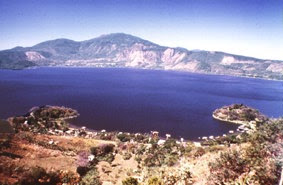
Towering over the city that bears its name, the long dormant volcano offers spectacular views and opportunities to hike along well maintained trails into the crater itself.

Lago de Ilopango
Formed in a giant volcano crater the lake, at 15 km long, 8 km wide and 248 metres deep, is the largest lake in El Salvador and a popular spot for fishing, boating and swimming. A Turicentro is located in the village of Apulo located near the lake and offering restaurants, picnic spots and boating. Fresh lake fish is a local speciality in the many restaurants rimming the lake in the village and there are a few basic hotels. http://www.nvmundo.com/travelinfo/elsalvador/sattract.htm
Formed in a giant volcano crater the lake, at 15 km long, 8 km wide and 248 metres deep, is the largest lake in El Salvador and a popular spot for fishing, boating and swimming. A Turicentro is located in the village of Apulo located near the lake and offering restaurants, picnic spots and boating. Fresh lake fish is a local speciality in the many restaurants rimming the lake in the village and there are a few basic hotels. http://www.nvmundo.com/travelinfo/elsalvador/sattract.htm


Monday, March 16, 2009
school

Public education was a higher priority than health care for government spending, and statistics reflected this disparity. School attendance and literacy in general increased notably in El Salvador as a whole during the twentieth century, particularly during the 1960s, when an ambitious program of school construction was carried out. Officially, literacy increased from 26.2 percent of the adult population in 1930 to 59.7 percent in 1971. By 1980 only 31 percent of the population aged ten years or older was considered illiterate.
The Salvadoran education system included one year of preschool, nine years of basic education, three years of secondary education, and higher education at two universities and several specialized postsecondary institutions. The curriculum at the basic and secondary levels, developed by the Ministry of Education, was uniform throughout the country. The provision of education, however, suffered from a rural-urban dichotomy. Countrywide statistics displayed the weakness of the school system on the secondary level; in a 1976 study, only 34 percent of students reached grade nine, and 15 percent reached grade twelve.
The Salvadoran education system included one year of preschool, nine years of basic education, three years of secondary education, and higher education at two universities and several specialized postsecondary institutions. The curriculum at the basic and secondary levels, developed by the Ministry of Education, was uniform throughout the country. The provision of education, however, suffered from a rural-urban dichotomy. Countrywide statistics displayed the weakness of the school system on the secondary level; in a 1976 study, only 34 percent of students reached grade nine, and 15 percent reached grade twelve.
Natural resources
some of el salvador's Natural resources are hydropower, geothermal power, petroleum, arable land. They spend $3.98 billion (2007 est.) on exports. offshore assembly exports, coffee, sugar, shrimp, textiles, chemicals, electricity. Imports: $8.667 billion (2007 est.): raw materials, consumer goods, capital goods, fuels, foodstuffs, petroleum, electricity. Major trading partners: U.S., Guatemala, Honduras, Nicaragua, Mexico, Germany, China (2006).
http://www.infoplease.com/ipa/A0107489.html
http://www.infoplease.com/ipa/A0107489.html
Subscribe to:
Posts (Atom)